

Cathodic protection and IoT – How remote monitoring helps safeguard critical pipeline infrastructure

Cathodic protection (CP) is vital for protecting steel pipelines against corrosion and extending their service life. Traditional manual inspections are time-consuming and leave assets vulnerable between checks. Transitioning to continuous remote monitoring with IoT sensors enables asset owners to track grid health in real time, comply with EN standards, and resolve faults before corrosion can take hold.
Thousands of kilometers of steel pipelines form the backbone of our vital infrastructure, transporting water, gas, and liquid fuels every single day. Because these assets are underground, they face a constant, invisible threat: corrosion. Left unchecked, soil and moisture eat away at steel, leading to leaks, environmental hazards, and expensive repairs.
Fortunately, cathodic protection can extend the operational life of these pipelines to well over 100 years. But it only works if the system is actually functioning.
Managing this protection traditionally required technicians to drive thousands of kilometers every year just to take manual readings. However, with IoT (Internet of Things), this is changing. This article discusses how cathodic protection works, why manual tracking falls short, and how remote monitoring helps pipeline operators secure their infrastructure efficiently.
What is cathodic protection?
Cathodic protection (CP) is an electrochemical method used to prevent corrosion on buried or submerged metallic structures.
In the ground, steel reacts to the soil, more specifically, to the oxygen and moisture in the soil. During this process the metal loses electrons to the oxygen and moisture and as a result turns into rust. To prevent this, the pipes have a coating that serves as a primary line of defense. However, this is not enough. To further protect the pipes and prolong their lifetime, a direct current (DC) is introduced to the pipeline. This causes the electrical potential of the steel to lower. The shift in potential then turns the entire pipeline into a cathode—the receiving end of the current—which stops the chemical reactions that cause rust.
Cathodic protection methods
Operators deploy cathodic protection using two main methods:
- Sacrificial anode systems: This method connects the steel pipeline to a “baser” metal, usually made of zinc, aluminum, or magnesium. Because these metals have a more negative electrochemical potential than steel, they corrode first. The base metal essentially sacrifices itself, sending a natural protective current to the pipeline. Once these anodes dissolve, they must be dug up and replaced.
- Impressed Current Cathodic Protection (ICCP): For larger pipeline networks, natural current from sacrificial anodes isn’t enough. ICCP systems use an external power source—a rectifier—connected to long-lasting anodes buried nearby. The rectifier converts AC power from the grid (or solar panels) into DC power, driving a continuous protective current across the entire length of the pipeline.
Moving towards proactive maintenance with IoT telemetry
Traditional maintenance relies heavily on manual field testing, which is heavily restricted by strict European regulatory framework and is costly in both time and money.
Moving towards a more proactive maintenance with IoT Telemetry allows you to monitor your pipleine infrastructure—from a distance with the use of smart sensors. Moving towards proactive maintenance with IoT telemetry allows you to monitor your pipeline infrastructure from a distance using smart sensors. These devices connect directly to your field assets, periodically collecting and transmitting encrypted measurement data to a central cloud environment.
If a threshold is crossed or a malfunction occurs, you get an alert instantly. The dashboard pinpoints the exact location of the issue and alerts you, so you can take action when needed. Additionally, you can always inspect performance trends over time and stay ahead of critical failures.
Monitoring your pipeline network with the Asset Monitoring Platform
The Asset Monitoring Platform (AMP) combined with our specialized telemetry hardware gives you complete visibility over your entire cathodic protection network. Shifting from manual control to remote control with IoT transforms CP from a manual chore into a continuous, data-driven utility. This improves your operation by:
By centralizing this data on the AMP, you gain the clarity needed to track infrastructure health, maintain compliance with European standards, and protect your network from the ground up.
Which cathodic protection systems does Withthegrid support?
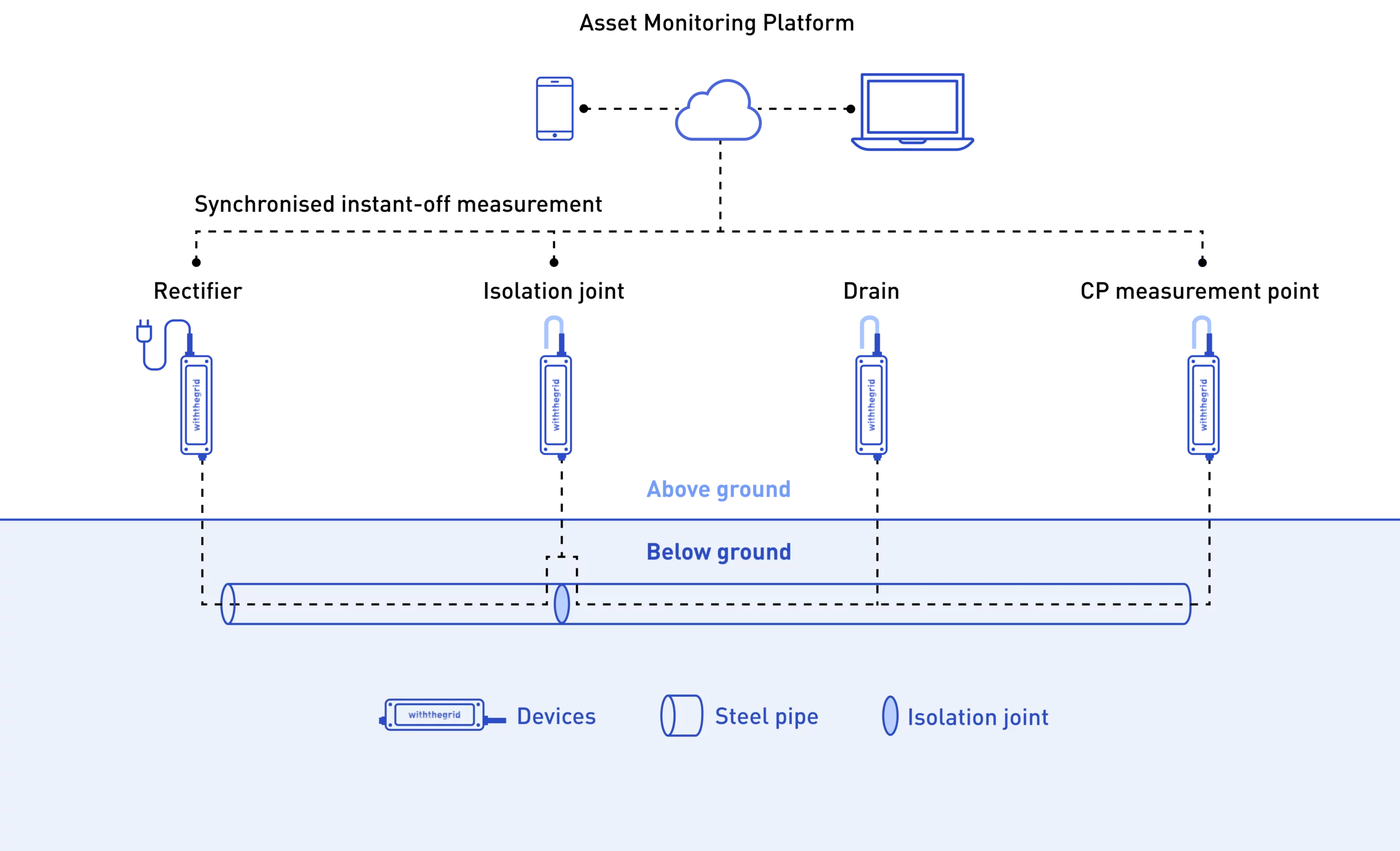
Here is how our sensors support your specific setup:
- Rectifiers: Monitor and switch your rectifiers using a reliable analog connection. If you need precise, synchronous switching, you can also connect an external relay.
- Modbus-connected rectifiers: If you use Amstel rectifiers with a Modbus connection, we provide a specific sensor for your setup. This allows you to adjust rectifier settings remotely and handle switching accurately and synchronously.
- Cathodic Protection (CP) test stations: You can place Withthegrid sensors directly inside your test stations, with the option to connect them to a coupon.
- AC / DC drainages: You can also install Withthegrid sensors inside drains. In these setups, the sensors measure both voltage and current.