
Realtime Interface (RTI): Everything you need to know

The Realtime Interface (RTI) is the Dutch grid’s emergency mechanism to manage severe grid congestion, mandatory since 2024 for all new or updated connection over 1 MW. This briefing outlines your legal compliance obligations, technical requirements, and how certified endpoints like the Teleport Gateway can help.
If you plan or own a solar park, wind farm, large battery, or any commercial-scale generation asset in the Netherlands, there is a good chance the Realtime Interface (RTI) will become part of your daily reality. For some it already has.
This article intends to be a briefing of what the RTI is, why it exists, how it works and what you have to do. We hope this read will help you understand the requirements, but if questions remain, you can always refer to Netbeheer Nederland's websiteSee: Netbeheer Nederland. Realtime interface: verdieping. or contact us via the form at the bottom of this page.
The problem the Realtime Interface was built to solve
The Netherlands is in the middle of an electricity transport crisis. Look at the Capacity mapSee: Netbeheer Nederland. Capaciteitskaart. for any month in the last three years and you will see the same picture: most of the country colored red, meaning there is no transport capacity available without joining a waiting list.
This is the consequence of a shift in how we use our electricity grid. For a hundred years, it was a centralized “one-way road”: a small number of large power stations sent electricity to a large number of consumers. Today, the system is decentralized, meaning the road has cars going both ways. Solar panels on the roofs of warehouses, wind farms in the polders, batteries behind industrial sites — they all feed power back. The grid was not built for this, and now we are asking it to do something it was never designed to do.
The first response is obviously to build more grid: more copper and thicker cables, bigger transformers and new substations. The grid operators are already doing this at scale,For instance, the Dutch grid operators planned investments of over €8 billion annually through 2026 to expand energy networks amid rising demand.
See: Netbeheer Nederland. (2023, November 1). Netbeheerders presenteren recordplannen en stellen andere aanpak voor. Netbeheer Nederland. but there is a limit to how fast you can expand the grid.It’s worth noting that grid reinforcement projects are also held back by a shortage of technicians, rising material costs, and long delays for permits and land access. Something else has to give.
That’s why we saw emerging in recent years a full toolkit of market-based tools for managing congestion. Capacity Limiting Contracts (CBC), GOPACS, Blokstroom, and similar mechanisms give grid operators ways to work with asset owners and market parties to reduce feed-in or take-off before critical limits are reached.
But markets have gaps. There are moments — such as a sudden incident or an unexpectedly high amount of generation or consumption — when the grid operator needs to act immediately and the commercial mechanisms are either unavailable or their time-frame has expired. At that point, the operator needs a last-resort tool: the ability to send a direct, binding instruction to a specific installation to reduce its output right now, without negotiation.
That tool is the Realtime Interface.
It’s the Dutch grid’s “emergency button” for congestion management. It sits at the end of the chain — after CBC, after GOPACS, after everything else — and activates only when those mechanisms have not been enough.
The regulation behind it
The idea of the RTI did not appear out of thin air. It’s the Dutch implementation of obligations that already existed in European law, sharpened by Dutch grid code revisions that came into force in 2022 and 2023.
The Article 14.2 of the Requirements for GeneratorsArticle 14.2:
“Type B power-generating modules shall fulfil the following requirements in relation to frequency stability:
(a) to control active power output, the power-generating module shall be equipped with an interface (input port) in order to be able to reduce active power output following an instruction at the input port; and
(b) the relevant system operator shall have the right to specify the requirements for further equipment to allow active power output to be remotely operated.”
See: European Commission. (2016). Commission Regulation (EU) 2016/631 of 14 April 2016 establishing a network code on requirements for grid connection of generators (Article 14(2)). Official Journal of the European Union. requires type B generators (installations between 1 MW and 50 MW) to have an interface that allows the grid operator to send remote setpoints for active power reduction. The same article gives the local grid operator the right to specify what that interface should look like.
The following year, Netbeheer Nederland, working with market parties (including Withthegrid!You can actually read more about the process of transforming the Teleport into the first Realtime Interface certified customer endpoint in the following article: Tech in action: Building the first certified Realtime Interface endpoint.), developed a joint national standard. The first public version of the RTI specification was published in April 2022, then later updated.You can find the latest version here: Netbeheer Nederland. Realtime interface: verdieping. Additionally, the RTI was further anchored through several articles in the Dutch Netcode Elektriciteit.Specifically:
– Article 9.12 (connecting it to the Besluit uitvalsituatie hoogspanningsnet, in force 1 January 2021),
– Article 3.15 lid 13 (broadening the legal basis, in force 11 May 2023),
– Article 3.17 lid 1 (requiring system operators to publish their technical requirements on their website).
💡 The main rule asset owners need to remember is the following: since 1 January 2024, the RTI is mandatory for all new or updated connections above 1MW in the Netherlands.
What the Realtime Interface is
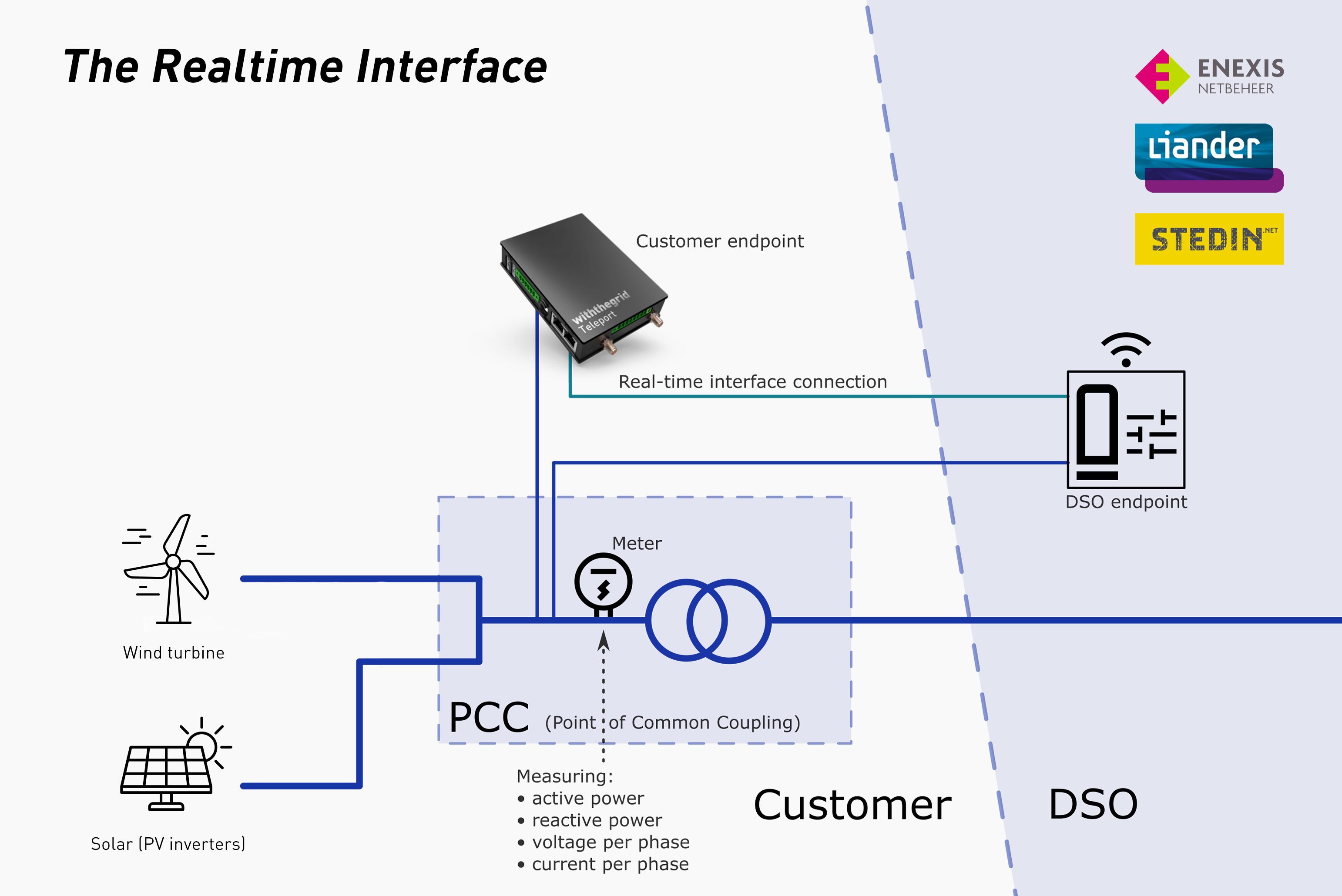
The Realtime Interface is a defined communication interface between a grid operator (such as Liander, Enexis, Stedin) and the owner of a connected installation (which can be an electricity production unit, a consumption installation, an electricity storage unit, or a combination thereof).
Through this interface, two things happen:
- The “grid operator endpoint” sends operating constraints, typically a setpoint for the maximum active power allowed at the connection point.
- The “customer endpoint” (asset owner side) sends measurements: real-time values of active power, reactive power, phase voltages, and phase currents at the connection point. It is also capable of receiving the grid operator’s setpoints and regulating the unit based on its value.
That’s it. No commercial signals from balance responsible parties or aggregators are involved. The RTI is operational infrastructure, not a market mechanism.
The setup

In terms of setup, the two endpoints are connected by an ethernet cable and use the IEC 61850 communication protocol.
The ownership boundary sits at the connection point. The grid operator installs their own unit inside your substation room — owned and maintained by them. Your customer endpoint rests on your side of the connection point and is your responsibility.
What flows across the RTI: setpoints, measurements, reasons
The current RTI specification defines a precise set of values that flow in each direction.
From the system operator to the asset
The most important message is the active power setpoint. This sets the upper limit of active power that is allowed at the point of common coupling. It comes in three flavours:
- as a percentage of the maximum capacity of the installation,
- as an absolute upper limit on generation in MW,
- or as an absolute upper limit on consumption in MW.
A positive value limits generation; a negative value limits consumption. Only one operational setpoint is active at any moment.
Critically, every operational setpoint comes paired with a reason code.The reason must be sent first. The setpoint must follow within 10 seconds. If the setpoint arrives later than that, the customer endpoint must reject it. If multiple reasons arrive before a setpoint, only the last one counts. Each setpoint needs its own fresh reason. These rules exist to make sure setpoints and their purposes are never accidentally decoupled. The reason tells the asset owner why the setpoint is being sent.
The reason code matters because not all setpoints are equivalent in how they may be fulfilled. When a setpoint is sent for the purpose of frequency stability, the asset is required to actually reduce its generation — increasing local consumption to mask the generation does not count. For most other reasons, the asset owner is free to comply by either reducing generation or increasing consumption, as long as the net power at the connection point respects the limit.
Beyond the operational setpoint, the grid operator also configures the safe-mode behavior. The safe-mode setpoint is the fallback value the asset must adopt if communication is lost, and has a fallback timeout defining how long communication has to be down before safe mode kicks in. Both of these are remotely configurable by the grid operator.
From the asset to the system operator
The customer endpoint continuously sends measurementsAll at class 1 accuracy as defined in IEC 61869. taken at the point of common coupling:
- active power,
- reactive power,
- phase voltages (both phase-to-ground and phase-to-phase),
- and phase currents.
Each value flows up several times per second.
If the connection drops and is later restored, the customer endpoint is also required to push buffered measurements covering the gap.15-minute average, maximum, and minimum values of active power for the last eight hours. This way, the grid operator does not have a blind spot in their records when communication is interrupted.
Availability
The RTI’s value depends entirely on its reliability. If the grid operator cannot rely on the connection, they lose the ability to apply a proportionate response at a critical moment. The specification sets the availability requirement at 99% over rolling six-month periods. Additionally, communication between endpoints must not exceed 4 seconds, allowing the RTI to respond rapidly to evolving grid conditions and prevent disruptions.
The three versions: where we are now, where we are going
The RTI is being rolled out in three planned versions, each with a different scope and a different technical underpinning.
- NBNL RTI v1.0, in active rollout since 2024. It uses the physical local connection described above, between the grid operator’s cabinet and your endpoint inside the same building or premises.
- NBNL RTI v1.1, with rollout indicated from 2026, adds an additional layer of security (TLS encryption) on the local data connection. The architecture stays the same; the cable still runs between two endpoints under the same roof.
- NBNL RTI v2.0, expected from 2028 or later, will be a fundamentally different beast: an internet-based connection between endpoints, replacing the dedicated cable with secure communication over public networks. This is the long-term, scalable architecture, designed for an estimated 10,000+ installations across the country. By the time v2.0 arrives, the European Commission is expected to have published an updated RfG (a revision is anticipated in 2025), which may shape what v2.0 ultimately looks like.
If you are reading this in 2026, your concern is v1.0, possibly with a future migration to v1.1.
What you have to do: the customer obligations
A clear-eyed list of what falls on the asset owner’s plate.
- You provide the physical space and power supply to host the grid operator’s cabinet inside your substation room, plus the ethernet cable that connects their cabinet to your endpoint. The grid operator handles the installation of their own endpoint, but you prepare the conditions for it.
- You select and install a customer endpoint that has passed compliance verification against the RTI specification. The list of certified products is published on Netbeheer Nederland’s RTI page, but we obviously recommend the Teleport Gateway.
- On the security side, a defined set of cybersecurity measures applies to your endpoint, and you must complete a short awareness video published by Netbeheer Nederland before commissioning. The resulting certificate needs to be shared with your grid operator.
- Last, you put a name against the asset. Setpoints flow automatically, but someone on your side needs to be reachable when configuration changes, incidents, or version updates come up.
What this means for your operations
For most asset owners, the RTI is inactive most of the time. The connection is up, the setpoint sits at 100%, the inverters do what the irradiance allows, and the meters tick over. Nothing happens, and that’s the point: the RTI only meant as an instrument of last resort.
When the RTI does activate, it’s because the grid operator has assessed that the limits within which the grid can be safely operated are being exceeded, and no market-based solution has resolved the situation in time. The grid operator sends a reduced setpoint with reason code.E.g. reason code 0001, which indicates the activation of an emergency curtailment The selection of which assets are curtailed is non-discriminatory.The toepassingskader noodcurtailment, the framework agreed at national level for emergency curtailment, leaves grid operators free to determine their selection method within the technical possibilities of the connection, as long as it is non-discriminatory, transparent, and verifiable.
See: Netbeheer Nederland. (2024, July 5). Toepassingskader noodcurtailment teruglevering (Versie 1.0).
Your installation must begin reducing power within 10 seconds and complete the adjustment within two minutes. When the constraint passes, another reason codeE.g. reason code 0000, which indicates the release of an emergency curtailment. is sent and the setpoint returns to the contracted maximum.
When curtailment is invoked under the “emergency curtailment” (“noodcurtailment”) framework, the redispatch fee defined in Article 13.7 of Regulation (EU) 2019/943Article 13.2: “The resources that are redispatched shall be selected from among generating facilities, energy storage or demand response using market-based mechanisms and shall be financially compensated. Balancing energy bids used for redispatching shall not set the balancing energy price.”
See: European Parliament & Council. (2019). Regulation (EU) 2019/943 of the European Parliament and of the Council of 5 June 2019 on the internal market for electricity (recast). Official Journal of the European Union, L 158, 125–199. applies. You are compensated for the energy you were prevented from producing.Total compensation = Imbalance costs + Lost subsidies + Lost GoO revenues.
Learn more in our article: Realtime Interface (RTI): Financial compensation scheme . The RTI itself does not handle that compensation — that is a separate administrative process — but it is the RTI that makes targeted, verifiable curtailment possible and therefore makes the compensation calculable.
The Teleport Gateway as customer endpoint
Once you know you need a customer endpoint, the next question is which one. The certified product list published by Netbeheer Nederland currently includes a small number of compliant solutions for the customer side. Among them is the Teleport Gateway.
The Teleport is a local energy management system that sits on your site and handles the RTI connection as one function among several. It was certified compliant with RTI, and was developed in direct collaboration with Enexis, Liander, and Stedin.You can actually read more about the process of transforming the Teleport into the first Realtime Interface certified customer endpoint in the following article: Tech in action: Building the first certified Realtime Interface endpoint.
What makes it relevant beyond bare RTI compliance is that it does not reduce your asset to a passive recipient of curtailment signals. The Teleport handles the DSO’s emergency setpoint, but also accepts control signals from your energy trader or aggregator — for price-based curtailment, FCR, aFRR, GOPACS, and more — and apply Grid Guard local control logic to protect your grid connection limit at all times.
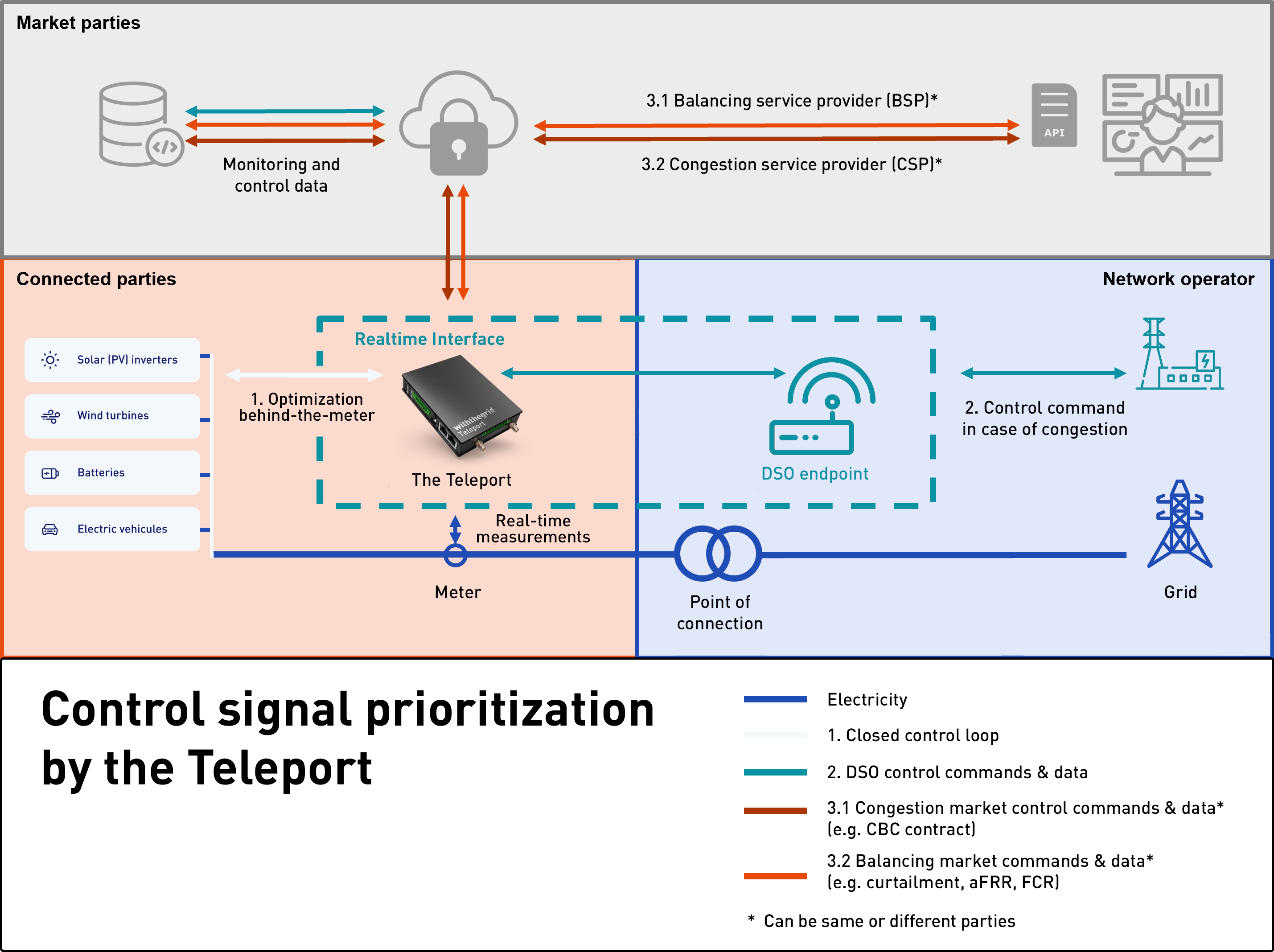
When the DSO sends an RTI setpoint, it takes priority over everything else; the Teleport enforces that hierarchy automatically. But when there is no RTI signal, the asset operates normally under your trader’s instructions or the Teleport’s own local strategies to optimize behind-the-meter.
Practically, this means you do not need separate hardware for grid compliance and for market participation.
The Teleport connects to over 450 asset typesYou can check if you asset is supported via our Asset Library Search Tool. — solar inverters, wind turbines, batteries, EV chargers, and power meters, across all major brands. If your asset type is not yet in the library, Withthegrid adds the integration at no charge.
Interested? You can request your Teleport by contacting us via the form below.
The bigger picture
Step back and the RTI looks like a small thing, but it represents a real shift in how the relationship between the grid and the assets connected to it is structured.
The RTI establishes something new: a standardized, verified, legally grounded channel through which the grid operator can reach into a distributed asset and say, during an emergency, not more than this. The asset owner will be reimbursed for the cost it incurred.
If you are connecting a new asset above 1 MW in the Netherlands today, the RTI is part of the package. Understanding it properly means you will not be surprised when that day comes.