

Negative electricity prices: what they are, why they happen, and how to manage the risk

Electricity prices can go negative. When that happens, producers pay to feed power into the grid instead of earning from it. To understand why, it helps to first understand the two markets where this risk shows up: the EPEX day-ahead market and the imbalance settlement system.
Energy producers interact with two main price signals to manage their output and revenue: EPEX day-ahead prices and imbalance prices. These figures reflect different timeframes and system needs. Understanding how they work is the first step toward managing the financial risks associated with power generation.
EPEX day-ahead market: forecasting tomorrow
EPEX SPOTEPEX SPOT is a European electricity exchange where short-term power is traded, mainly through day-ahead and intraday markets. It helps match supply and demand and set prices for electricity delivered the same day or the next day across many European countries. is a leading power exchange in Europe, facilitating the trading of electricity across various countries. The day-ahead market is an important component of EPEX Spot, where Balancing Responsible Parties (BRPs)Balancing responsible parties (BRPs) are market participants responsible for keeping electricity supply and demand balanced, usually on a 15-minute basis, and reporting their planned volumes to TenneT.
In practice, every electricity supplier must have a BRP, either inside its own organization or as an external service provider. buy and sell electricity for delivery the following day.
The process follows a set schedule:
- Each day, BRPs submit bids for specific hours of the next day.
- At 12:00 CET, the order book closes and the market clears.
- The clearing process matches bids and offers by price and volume to meet demand at the lowest possible overall cost.
The price at which total supply equals total demand becomes the market-clearing price, and will be the same for every participant in that delivery period. That price is what most people mean when they say “the EPEX day-ahead price.”
Imbalance prices: real-time accountability
While day-ahead prices are based on forecasts, imbalance prices relate to what happens in real time.
BRPs submit scheduled programs to TenneT (the Dutch transmission system operator) specifying how much energy their portfolio will generate or consume in each settlement period.The Netherlands uses a 15-minute imbalance settlement period for imbalance prices.
When real-time production or consumption deviates from those schedules, a BRP creates an imbalance. Whether that imbalance costs or pays depends on how it affects the grid:
- If your deviation makes the grid’s imbalance worse, you pay the imbalance price.
- If your deviation helps correct the system’s imbalance, you receive the imbalance price.
TenneT publishes imbalance prices in near-real-time. They reflect the cost of TenneT intervention for balancing the system (with the activation of other balancing products such as FCR, aFRR…) due to deviations from the BRPs scheduled plans.
Those costs pass directly to the BRPs responsible for the deviations; it works as a direct financial incentive to keep their portfolio balanced.
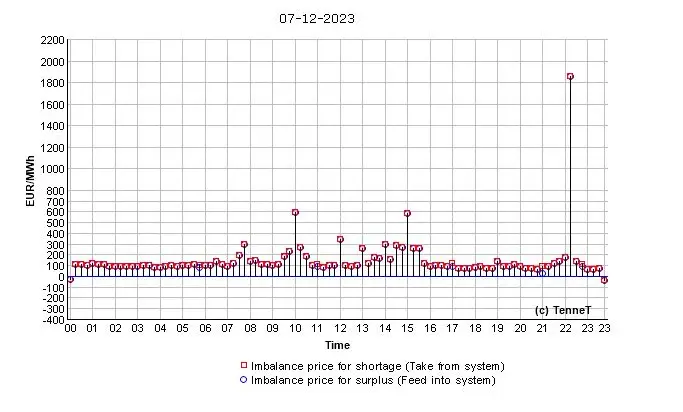
Exemple of imbalance prices published by Tennet – Data from the 7th of December 2023.
When do electricity prices go negative?
Negative prices occur when supply exceeds demand. In these instances, producers must pay to feed energy into the grid.
This happens most often during periods of high renewable generation combined with low demand,In the Netherlands, the most negative price periods are typically clustered in late spring and summer, especially around May to August, with weekends and holidays contributing most strongly. In 2024 and 2025, the records were respectively €-34.8/MWh and €-44.8/MWh. such as a sunny afternoon in spring when industrial activity is low. At those moments, there is simply more electricity on the grid than the system needs. Grid operators cannot easily switch off large generators, so prices fall — and can fall below zero.
For consumers, negative prices are an unexpected benefit. For producers, they create a direct financial problem.
How negative prices affect producers
The financial exposure depends on your contract structure.
Dynamic contracts indexed on EPEX day-ahead prices
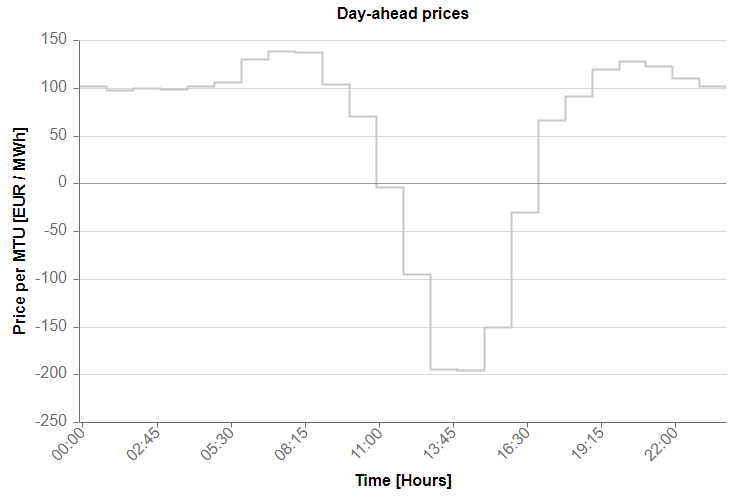
If your contract is indexed to EPEX day-ahead prices, you receive (or pay) the spot price for every MWh you produce. During negative price intervals, you do not just miss revenue — you actively pay for each MWh you feed into the grid.
Imbalance risk
When signing a trading contract, producers can choose to carry their own imbalance risk or transfer it to their BRP in exchange for a fixed premium.
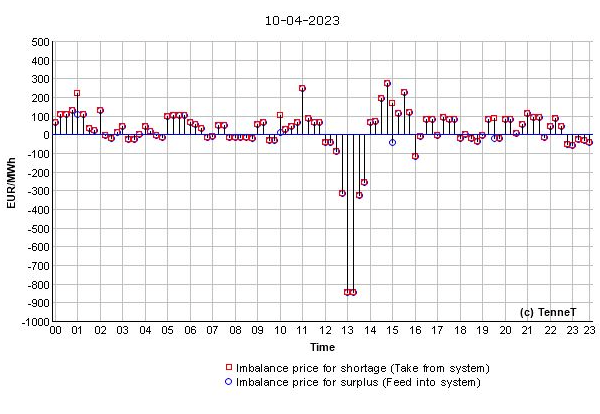
If you carry the risk yourself and the imbalance price turns negative during a period when you overproduce relative to your schedule, you pay for that overproduction.
Ways to reduce exposure to negative prices
1. Curtailment
CurtailmentFor more details, we encourage you to read “What’s curtailment?”. means intentionally reducing your asset’s output during periods of oversupply.
Done reactively, it limits losses: if you stop producing when prices go negative, you avoid paying to feed in. Done proactively, it can generate revenue: if the system is short and imbalance prices are negative (meaning the grid has excess supply), reducing your output below your scheduled program means you produce less than planned, which helps correct the system — and TenneT compensates you for it.
Curtailment requires the ability to control your asset in real time, with a fast and reliable signal chain between your trading system and the physical asset on site.
2. Energy storage
Pairing a battery with your generation asset gives you a third option: absorb excess production locally rather than curtailing it or paying to export it.
During a negative-price interval, a battery can charge from on-site generation instead of pushing that power onto the grid. When prices recover, the stored energy can be discharged and sold at a better rate.
This approach requires a control layer that can coordinate the battery and the generation asset automatically, responding to market signals in real time.
How the Teleport helps
The Teleport Gateway is an on-site controller that sits between your physical assets — solar, wind, batteries — and your trading systems.
When your BRP or aggregator sends a curtailment or charging/discharging signal, the Teleport executes it on the asset instantly.
If cloud connectivity drops, its local control logic continues to run independently, protecting your grid connection and following pre-set fallback behaviour.
This means your energy asset can respond or coordinate depending on prices.
The Teleport also open more possibilities, such as participating to balancing or congestion markets via your trader for extra income.

Want to learn more about flexibility?
Here are some recommended reads:


